Bhutan at the Crossroads
The kingdom travelers dream of visiting is losing its youth to migration and its north to China—can it hold on?
Tucked into the folds of the eastern Himalayas, Bhutan feels like a place the modern world forgot. Ancient monasteries cling to cliffs above the clouds; red-robed monks chant in temples and walk roads lined with prayer flags. The kingdom doesn’t court the masses. Between its daily tourist fee and limited entry, it has quietly become one of the world’s most exclusive destinations — drawing wealthy travelers for luxury lodges and bragging rights, and adventurous ones for high-altitude trekking and culture. This is a country that measures success not in GDP but in Gross National Happiness, a philosophy woven into everything it does.
Bhutan only opened to tourism in 1974; television and the internet didn’t arrive until 1999. Wedged between China, India, and Nepal, it has deliberately charted a quieter, cleaner course than any of its neighbors. There are no neon signs, no traffic lights, no backpacker bars—just a landscape that feels almost untouched. As Matt DeSantis, CEO of MyBhutan, put it: “The highest unclimbed mountain in the world is in Bhutan, and because it’s considered sacred, it will remain unclimbed. You have everything from snow leopards in the north to elephants and tigers in the south. Bhutan is an incredibly biodiverse hotspot.”
That preservation comes at a price — literally. Every traveler pays a $100 daily Sustainable Development Fee (rising to $200 in 2027), which funds free healthcare and education while protecting the country’s cultural fabric. As our guide, Tul-C, described it, this isn’t a tourist tax so much as an investment in a civilization worth keeping.
To visit at all, you must book through a licensed tour operator, who arranges your visa and itinerary—within that structure, trips can be tailored to your interests, from textile art to wildlife tracking. Entry is limited to a handful of gateway cities (Bangkok, Kathmandu, Singapore, New Delhi, Dubai); flying in from Kathmandu, take a left-side window seat for views of Everest.
Descending into Paro Valley, I pressed my face to the window, mesmerized. The single-story terminal — ornate, colorful, built without a single nail per centuries-old tradition — set the tone immediately. Everyone wore traditional dress; a giant photo of the king and royal family greeted arrivals. At 7,200 feet, the air was thin and impossibly clean.
Coming from Nepal’s chaos, the contrast was jarring. I’d visited close to 100 countries and am admittedly hard to impress. Bhutan impressed me instantly — not as a tourist attraction, but as a living, breathing culture that exceeded years of expectation. From Paro, we wound through the mountains to Thimphu, Bhutan’s capital of 149,000. Our first evening, at the King’s Memorial Chorten, butter lamps flickered as students, office workers, and elders circled the temple chanting — faith expressed through the body as much as the mind.
The next day brought Simtokha Dzong and Dochula Pass, where 108 white stupas ring a panorama of the eastern Himalayas, and prayer flags carry mantras on the wind for miles. We visited a weaving factory and Pangi Sampa Monastery before returning to Thimphu, each curve in the road delivering another view that stopped conversation mid-sentence. Inside the temples — among the most intricate and beautiful I’ve seen anywhere — murals, gold statues, and geometric patterns create a visual feast. Photography is banned inside; our guide simply said, “Take off your shoes and leave your camera behind.” Without a screen between you and the room, you remember more.
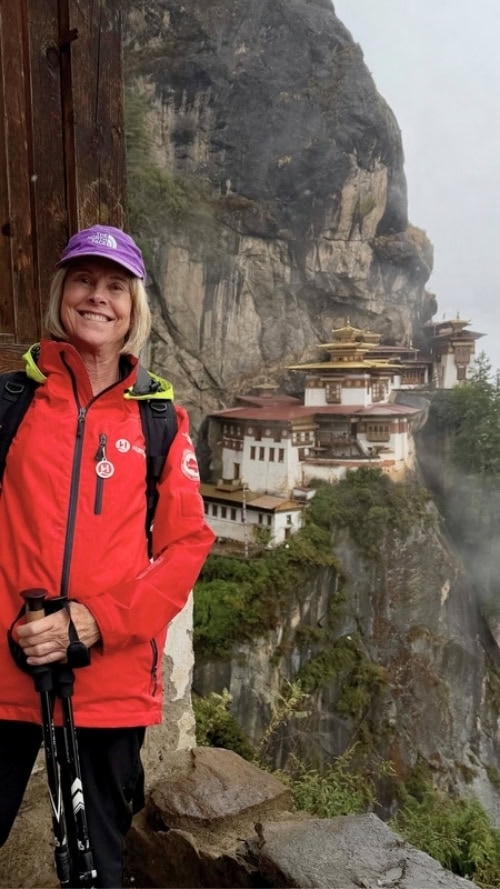
Paro itself is small and walkable, but one hike defines every visit: Taktsang Monastery, the Tiger’s Nest, perched at 10,121 feet on a sheer cliff. It’s usually saved for the last day, once you’ve acclimatized. It’s demanding, but most visitors in decent shape complete it.
We climbed in unseasonable, driving rain. Half our group attempted it; four of us reached the top — 1,500 feet up, over a thousand stone steps, the monastery appearing and vanishing through cloud the whole way. Once there, the sublime stillness of this 8th-century site made every step worth it. I’ve stood in remarkable places worldwide. Tiger’s Nest is among the few that genuinely stopped me still.
That stillness, though, sits atop real change. Bhutan’s 44-year-old king — educated at Phillips Academy Andover, Cushing Academy, Wheaton College, and Oxford — embodies the bridge between tradition and modernity. In 2024 he held audiences in Sydney, Canberra, and Perth with roughly 27,000 Bhutanese expatriates, sharing plans for Gelephu Mindfulness City, a special economic zone meant to diversify the economy beyond hydropower and tourism.
The reason for that push is visible beneath the surface: Bhutan’s population is shrinking as young people leave for opportunity abroad, with Australia now home to a large diaspora. The kingdom is trying to hold onto its cultural soul while building a future that gives its youth a reason to stay.
There’s also pressure from outside its borders. Satellite imagery and independent research indicate China has built roughly 22 villages and settlements inside Bhutan’s northern territory since 2016, relocating thousands of settlers from Tibet along with soldiers and officials, and Bhutan has lost an estimated 2 percent of its land in the process. Bhutan’s government has downplayed the reports, and decades of border talks with Beijing remain unresolved. Squeezed between China to the north and its closest ally, India, to the south, tiny Bhutan has little leverage of its own — a quiet reminder that the kingdom’s isolation, however deliberate, doesn’t put it beyond the reach of its giant neighbors.
To visit Bhutan now is to watch that balance being struck in real time — a country honoring its past while quietly, deliberately, writing what comes next. Go. Stay long. Pay attention. You won’t regret it.