
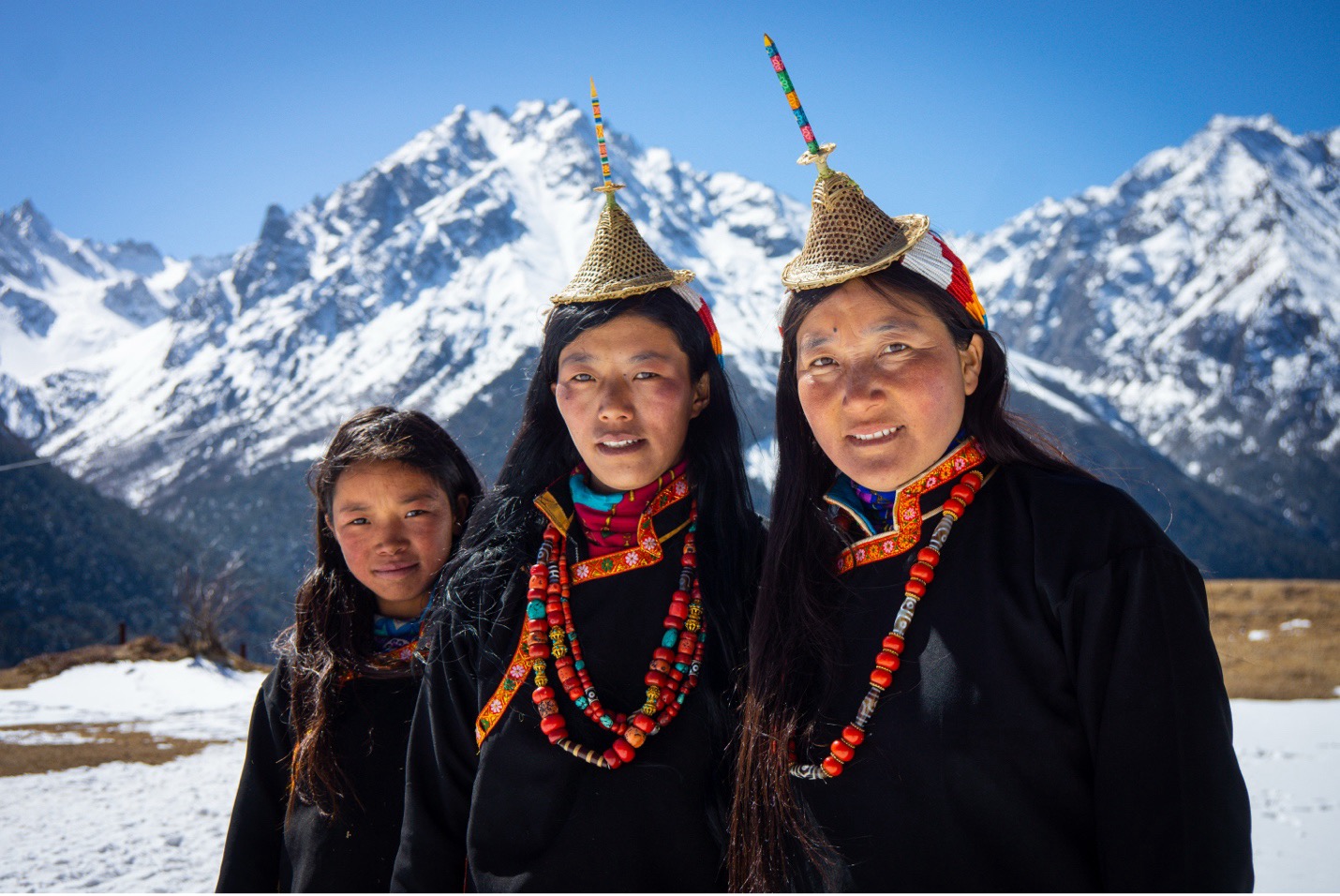
Laya woman from one of the world’s highest permanent human settlements. Photo by Matthew DeSantis, courtesy of MyBhutan
A Kingdom Apart
Bhutan’s geographic and cultural isolation has been its greatest asset. The kingdom only opened to tourism in 1974, and television and internet didn’t arrive until 1999. Surrounded by China, India, and Nepal, it has deliberately charted its own course—cleaner, quieter, less frenzied, and remarkably well-preserved compared to every neighbor it borders.
Nowhere in Bhutan will you see neon signs or traffic lights. No backpacker bars or cheap hostels clutter the landscape. The country seems untouched by the visual chaos of modern development, surrounded instead by jaw-dropping natural beauty that feels almost surreal in its intactness.
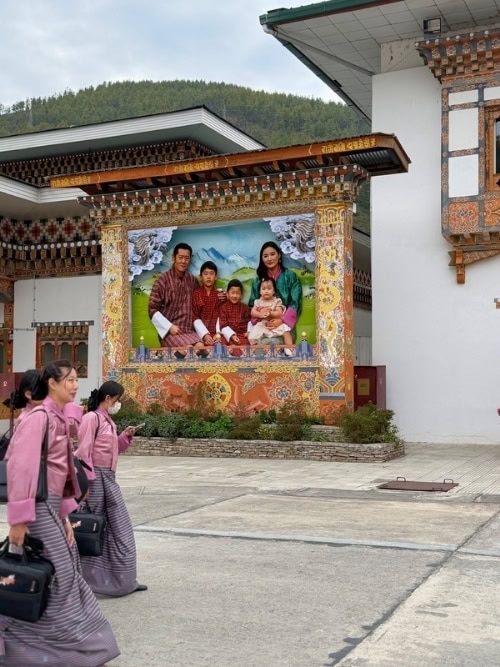
Traditional architecture and employees wearing local costumes greet visitors at Paro International Airport with a portrait of the Royal Family.
Matt DeSantis, CEO of MyBhutan and one of the country’s longest-engaged foreign residents, puts the scale of this preservation into perspective: “The highest unclimbed mountain in the world is in Bhutan, and because it’s considered sacred, it will remain unclimbed. You have everything from snow leopards in the north to elephants and tigers in the south. Bhutan is an incredibly biodiverse hotspot.”
The Philosophy Behind the Fees
The Bhutanese fiercely protect their unique Buddhist culture through a deliberate policy of attracting “high-value” tourists who will visit without damaging the environment or cultural fabric. All travelers pay a $100 daily Sustainable Development Fee (SDF) through their tour company—currently scheduled to increase to $200 in 2027.
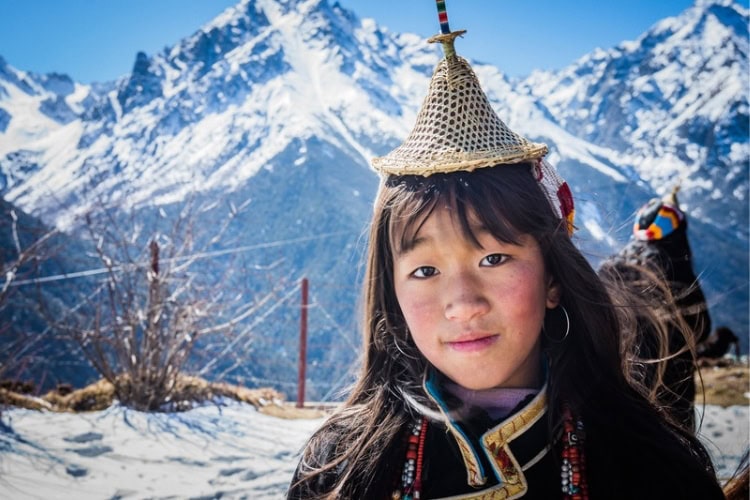
Photo: Bhutanese Woman in the Himalayas. Credit: Matthew DeSantis.
Our guide, Tul-C, thanked us for this contribution, explaining that it funds free medical care and education for all citizens while preserving the country’s cultural treasures. It is not a tourist tax so much as an investment in a civilization worth keeping.
How to Actually Get There
To enter Bhutan, you must work with a licensed tour company or guide—the only way to obtain a visa and travel within the country. While this limits independent travel, it doesn’t mean you’re trapped in a rigid itinerary. Experienced operators can customize trips around your specific interests, from textile art to wildlife tracking to spiritual immersion.
You can only enter from select cities: Bangkok, Kathmandu, Singapore, New Delhi, and Dubai. If you fly the one-hour route from Kathmandu, secure a window seat on the left side of the aircraft—you’ll be rewarded with views of Mount Everest piercing the sky. Ensure you have correct documentation for passing through India or Thailand en route, and verify transit visa requirements well in advance.
Touching Down in a Different Era
The Descent into Paro Valley
As our Druk Airways plane descended into Paro Valley, I pressed my face to the window, mesmerized by the landscape below. Stepping onto the tarmac felt like entering another era. The colorful, single-story terminal showcased Bhutan’s distinctive architecture—ornate, fanciful, built entirely without nails according to centuries-old tradition.
The Paro Valley stretched before us, cradled by majestic peaks. Every person I saw wore traditional Bhutanese dress, and an enormous, vibrant photograph of the King and royal family greeted visitors at the entrance. At 7,200 feet altitude, I felt slightly dizzy as I breathed in the impossibly clean mountain air.
First Hours in the Kingdom
Coming from the chaos of Nepal, the contrast was jarring. This was a country that had made deliberate choices about what to let in and what to keep out—and the result was visible in every direction. I had visited close to 100 countries and lived abroad for decades. I am admittedly hard to impress. Bhutan impressed me immediately.
Bhutan had occupied a place on my travel bucket list for years. I wanted to witness the authentic Buddhist way of life—not as a tourist attraction, but as a living, breathing culture. What I discovered exceeded my expectations. Bhutan didn’t just meet the hype; it completely transformed my understanding of what a country can choose to preserve and protect.
Life in the Capital and the Mountain Roads
Thimphu at Dusk
From Paro, we wound our way through mountain roads to Thimphu, Bhutan’s capital and largest city, home to 149,000 people. Our first evening, we visited the King’s Memorial Chorten at sunset. The experience was magical, reminiscent of time I spent in Tibet decades earlier.
Butter lamps flickered in the darkness as students, office workers, families, and elderly citizens walked circles around the temple, quietly chanting prayers. I was struck by how Bhutanese religious practice combines quiet contemplation with physical movement—faith expressed through the body as much as the mind.
Into the Mountains: Dochula Pass and Beyond
The following day took us to Simtokha Dzong—a fortress monastery—en route to Dochula Pass, which offers breathtaking panoramic views of the eastern Himalayan range. The pass is a popular stop where visitors admire 108 white memorial stupas arranged in concentric circles against a backdrop of sky and stone.
Throughout the drive, hundreds of colorful prayer flags fluttered on hillsides, carrying mantras on the mountain wind. We visited a traditional weaving factory and stopped at Pangi Sampa Monastery before returning to Thimphu. Each curve in the road delivered another view that made conversation stop mid-sentence.
Inside the Temples
The temples throughout Bhutan rank among the most intricate, well-preserved, and beautiful I’ve encountered anywhere in the world. Brightly colored murals, golden statues, and dazzling geometric patterns create a visual feast that imprints permanently on memory.
Photography is strictly prohibited inside all Bhutanese temples—a rule our guide reinforced before each visit: “Take off your shoes and leave your camera behind.” This prohibition actually enhances the experience, forcing you to be fully present rather than viewing the world through a screen. You remember more when you can’t photograph anything.
The Climb to Tiger’s Nest
Paro: Gateway to an Icon
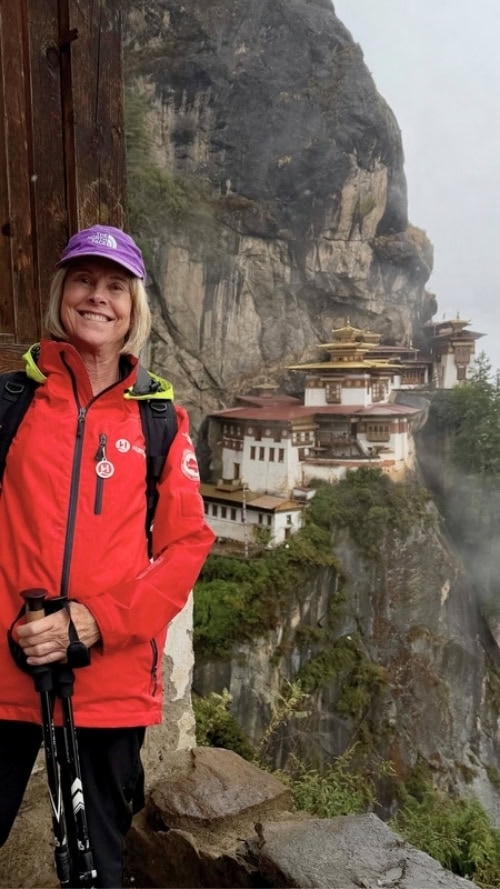
Paro is a compact town with a walkable downtown area filled with souvenir shops. The valley offers numerous trekking opportunities, but one hike dominates every itinerary: the legendary Tiger’s Nest, known formally as Taktsang Monastery, dramatically perched on a vertical cliff face at 10,121 feet.
This iconic day hike typically happens on the final day of your trip, after you’ve had time to acclimatize to Bhutan’s high altitudes. Is it challenging? Yes. But most visitors in good physical condition, with strong knees and proper acclimatization, complete it successfully—weather permitting.
Ascending in the Rain
Unfortunately, unseasonable heavy rain-soaked Bhutan on our hiking day. Despite this, half our group attempted the climb, and four of us reached the summit. The trail begins at 8,530 feet and ascends 1,500 feet over more than a thousand stone steps. Throughout the climb, views of the monastery clinging impossibly to the cliff take your breath away—both literally and figuratively.
Once you arrive, the sublime beauty and spiritual atmosphere of this 8th-century monastery make every difficult step worthwhile. I have stood in remarkable places across the world. Tiger’s Nest is among the handful that genuinely stopped me still.
Where to Stay and What to Eat
A Range of Accommodations
Bhutan’s accommodation options range from luxury resorts to heritage hotels to farmhouse stays. Luxury properties like Amankora and Six Senses offer spa facilities, traditional Bhutanese architecture with modern amenities, and stunning valley views. These feature local design elements including hand-painted woodwork, bukhari (traditional wood stoves), and prayer flags.
Heritage hotels occupy restored dzongs, farmhouses, or traditional buildings, offering authentic experiences with modern comforts. Thick stone walls, intricate wooden detailing, and interior courtyards give guests a genuine taste of historical Bhutanese living. Farmhouse stays go further, offering intimate cultural experiences in traditional homes where local families have converted portions into guesthouses.
My mid-range base in Thimphu—the Meridian Hotel—was unremarkable but well-located, allowing me to walk downtown, sit in cafés, and converse with locals. In Paro, I stayed at a newly opened five-star luxury property developed by a Singapore-based company. At 87 rooms, it’s Bhutan’s largest hotel. Every room features floor-to-ceiling windows, private balconies, and panoramic mountain views. After swimming a few laps in the heated indoor infinity pool, I found myself winded, having forgotten I was exercising at 7,200 feet.
An Honest Word About the Food
I was surprised that we ate nearly all meals in our hotels, typically buffet-style—meaning food often cooled quickly and selections grew repetitive. The two lunches at “local restaurants” proved disappointing: large tour groups crowded the dining rooms, and mediocre buffet food failed to showcase Bhutanese cuisine’s potential. The exception was the excellent Indian food at the five-star Dawa Hotel.
Traditional Bhutanese cuisine features dairy products, chilies, soft cheese, and rice as staples—an interesting culinary tradition worth experiencing when prepared well. Insist that your operator build in at least one genuinely local dining experience. It is the one area where standard tour itineraries reliably fall short.
Planning a Visit Worth Making
Go Deeper Than the Tourist Circuit
Matt DeSantis, (CEO, MyBhutan.com), advises travelers to customize trips around specific interests: “Whether it’s textile art, birding, foraging for traditional medicines, trekking, or spiritual experiences, ask your operator to build accordingly. You can hike and stay overnight in a monastery in the high mountains, where you may eat and meditate with monks, have dharma discussions, or even play football together.”
The Tseringma Sanctuary harbors extraordinary wildlife, including snow leopards, takin (Bhutan’s national animal), black bears, red pandas, and over 300 bird species—including the critically endangered, white-bellied heron, with only 60 remaining in the wild. Plan to attend smaller festivals where connecting with locals and experiencing village life comes naturally, rather than the larger, more tourist-heavy celebrations.
Temple Etiquette Worth Knowing in Advance
When visiting Buddhist sites in Bhutan, observe these essential courtesies: always check if photography is permitted (inside temples, it never is), remove shoes before entering, dress conservatively with covered knees and shoulders, never point your feet at Buddha statues or other people, and resist touching anyone’s head—even adorable children. Consider wearing slip-on shoes and socks on temple-heavy days for convenience.
My Biggest Mistake—And How to Avoid It
I should have known better than to think five days would provide a genuine understanding of Bhutan. Short visits confine you to the four main tourist hotspots in the western part of the country, which is exactly what happened to me. I left with a nagging feeling that I’d missed so much.
My advice: plan for at least seven to ten days. Travel in a small group or arrange a private tour. Tell your tour company you want to venture beyond the standard circuit—even into remote eastern Bhutan. Select an operator with deep Bhutanese experience and connections. Take time to truly absorb what Bhutan is.
A Kingdom at a Crossroads
The King and His Vision
Research Bhutan’s 44-year-old King and his ambitious vision for the country’s future. He has a beautiful wife and two children whose photographs grace public spaces throughout the kingdom. Educated at Phillips Academy in Andover, Massachusetts, then Cushing Academy and Wheaton College before studying at Oxford University, he represents Bhutan’s bridge between tradition and modernity.
In 2024, he held royal audiences in Sydney, Canberra, and Perth, meeting with approximately 27,000 Bhutanese expatriates—a striking image of a monarch travelling to his diaspora. During these meetings, he shared his ambitious plans for Gelephu Mindfulness City, a special economic zone under construction in southern Bhutan, designed to attract international investment in advanced technology and diversify beyond the current reliance on hydropower and tourism.
The Tension Beneath the Surface
While Bhutan appears to be a real-life Shangri-La, the complete picture is more complex. The population is shrinking as young people leave for economic opportunities abroad—Australia now hosts a large Bhutanese community. The country is attempting to preserve its cultural soul while creating economic opportunities that will keep its young people home.
Visiting now means witnessing this delicate balance firsthand—a kingdom choosing its own path into the future while honoring the wisdom of its past. It is a story being written in real time, and one that no photograph, however good, can fully capture. Go. Stay long. Pay attention. You will not regret it.