Top Five Sites to See in Berlin, Germany
My third trip to Berlin I realized you’ll never have enough days to see all you want to. Last year I visited friends who live in Berlin and these are their recommendations for Must See Sites.
Make it Fun
One of the most interesting tours I took in Berlin, was in a Trabant, or “Trabi” car. It has a tiny engine, sounds like a Harley and was the most popular car in East Germany. As you buzz around, everyone takes your photo because the car is so historic. Ours was painted like a leopard.
Check out Trabi Safari’s: https://cms.trabi-safari.de/opencms/opencms/trabi-safari/en/_main/routen_preise/content_0001.html
1.) Brandenburg Gate 
A symbol of Berlin, the remaining gate used in medieval times to enter the city. During the cold war it sat in no mans land, between West and East Berlin. On top of the gate is a Quadriga, a four house chariot that in Roman times were a symbol of triumph. The American Embassy and security guards flank the gate.
2.) Holocaust Memorial 
Dedicated to the thousands of Jews murdered during World War II, it consists of 2,711 austere rectangular grey blocks, void of any decoration. The blocks are identical, and range in size from 0.2m to 4.8 meters. Designed by Peter Eisenman, it is thought Eisenman wanted the visitor to feel uncomfortable and confused as they wandered through the undulating ground while at the same time being aware of the orderly shape of the rectangular blocks. It has caused much controversy, for now the blocks have become a playground to children who jump from block to block, or tourists taking pictures standing on the blocks.
3.) Checkpoint Charlie-A must for photographs! 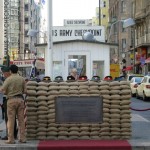
Checkpoint Charlie is the famous border crossing between East and West Berlin, where American and Russian forces stood against each other after the creation of the Berlin wall on August 13, 1961.
4.) The Berlin Wall 
There are still traces of the original Berlin Wall throughout the city. Its former path is embedded in the street and sections still stand today to serve as a reminder to visitors and locals alike.
5.) Stumbling Blocks 
Stumbling blocks are monuments placed throughout the city created by Gunter Demnig which commemorates individual victims of the Holocaust. There are small, cobblestone-sized memorials for an individual victim of Nazism. They are placed outside of houses, apartments and buildings where victims were taken from their daily lives and thrown into prison camps. They read “Here Lived…” and give the individuals name of deportation, death or rescue and which concentration camp they were placed into.
If you can’t find a stumbling block, ask a local person to point one out.
For more information, visit https://www.visitberlin.de/en